.jpg)
● TERASi is the only European manufacturer of its kind, delivering a flexible wireless communications system for contested environments that does not compromise on security, deployability and high-speed data capacity
● TERASi’s seed fund round represents one of the largest defence tech investments in Sweden and the firstin Sweden for many of its investors, including the NATO Innovation Fund, Ukrainian VC D3 and US national security VC In-Q-Tel
● The funding will accelerate thedeployment of its connectivity solutions to Europe’s armed forces, includingthrough partnerships with leading defence primes, and the development of acomplete system for the tactical edge that integrates communications, spatialawareness and electronic warfare
TERASi, a spinout from KTH Royal Institute of Technology, has raised €11 million to scale the deployment of its wireless systems for unjammable and undetectable communication, a pressing capability gap for Europe. The round was co-led bythe NATO Innovation Fund and JOIN Capital, with participation from new backers In-Q-Tel and D3, and returning investors Navigare Ventures, Almi Invest,Onsight Ventures, Further Than Capital, KTH Ventures.
Today’s defence and security doctrine is defined by autonomous systems and digitised command and control. This creates an urgent need for military forces to transmit large amounts of data securelyand in real-time between units, platforms and assets, even when on the move, in environments where conventional infrastructure has been destroyed, satellitelinks are unavailable, or GPS and the radio-frequency spectrum are being actively contested. Military forces often face limited bandwidth, high latency,and electromagnetic interference on the modern battlefield. So far, European nations have not had their own secure connectivity capabilities. TERASi solvesthis problem as the only European end-to-end producer of millimetre-wavehardware for tactical communications.
Using its patented AirCore technology, TERASi builds units that operate using millimetre-wave frequencies with highly directional beams which are invisible to conventional detection and jamming equipment. In contrast, current commercial and military solutions, which are omnidirectional and operate in a small range of frequencies, are easily intercepted. By tapping into the millimetre-wave domain, TERASi has unlocked anew frequency range, using highly focused signals. TERASi mm-wave devices are pocket-sized, compatible with any tactical platform and easily deployable in minutes on tripods or drones at a fraction of the cost and time of alternative solutions.
When deployed, these units create a wirelessand secure communications network that is unmatched in its speed, data capacityor resilience: its wireless communications links can transmit huge volumes ofgigabytes, up to 50 times faster than satellites, covering distances over 100km.
The funding will help scale its current rangeof connectivity solutions and grow its engineering and field team. It will alsoenable TERASi to develop new mm-wave based products and integrate them into asingle system to address three capability gaps: connectivity, spatial awarenessand electronic warfare.
Bringing together a team with expertise inengineering, microelectronics and RF design, 5G and 6G networks, andoperational insight from military backgrounds, TERASi works with leadingdefence primes, the Swedish Armed Forces, the European Space Agency and leadingEuropean telecoms providers.
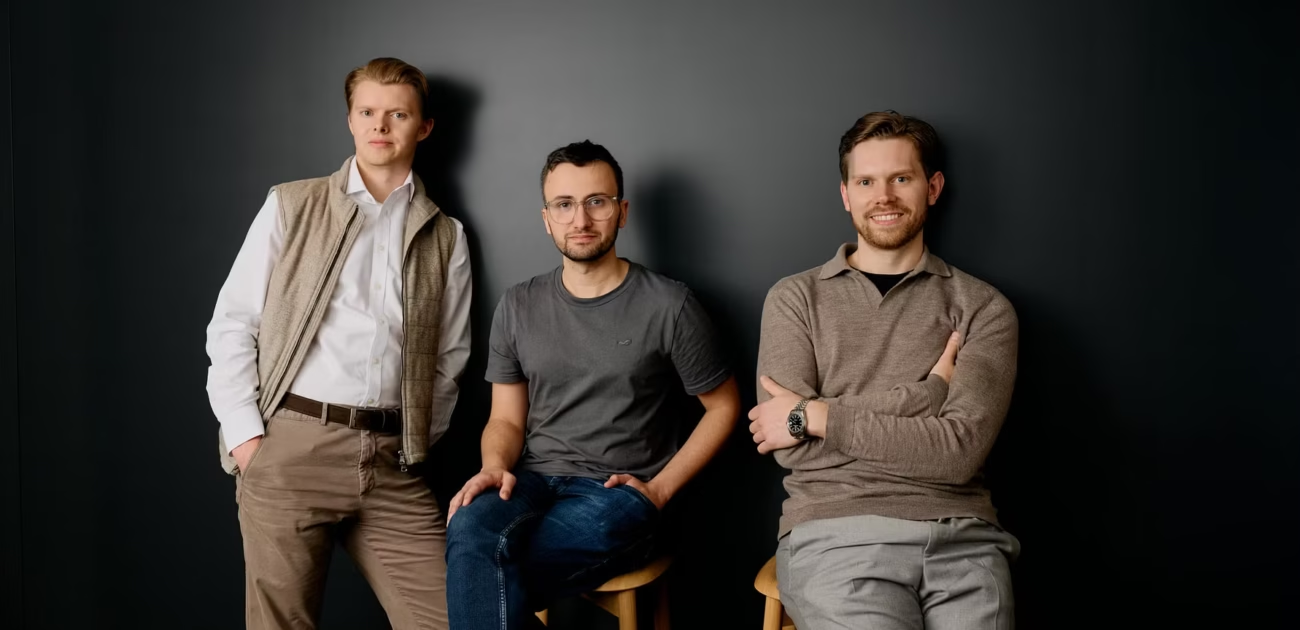
James Campion, CEO and Co-founder of TERASi,said: “Europe’s armed forces need to be able to move decisive informationsecurely, at speed, and in environments where infrastructure, satellites andthe spectrum itself may be contested. That is about more than connectivity. Itis about restoring Europe’s freedom to operate and communicate on its ownterms.
“The same need extends beyond defence.From critical infrastructure to remote and sensitive industrial operations,organisations need communications that remain reliable when fixedinfrastructure is unavailable, too restrictive or under attack. As hybridthreats increasingly target the systems our societies depend on, thatresilience matters far beyond the battlefield. With this funding, we can getthese capabilities into the field faster and take them further.”
Sander Verbrugge at the NATO Innovation Fund,said: “Connectivity is a decisive capability on the modern battlefield. Ashybrid warfare puts satellites, fixed infrastructure and GPS under constantthreat of jamming and spoofing, Allied nations need networks that can stand upin minutes and stay secure. TERASi's RU1 makes that possible: smaller, lighterand faster than all comparable systems - and built on millimetre-wavetechnology that is exceptionally hard to intercept or jam. There's simply noother technology in Europe, across defence and civilian markets, combining thatresilience, speed and efficiency in one deployable system. This is why we'reproud to back TERASi as the NATO Innovation Fund's first direct investment inSweden.”
Simone Lavizzari, Principal at Join Capital,said: “What impressed us about TERASi is how the team has taken sophisticatedMEMS technology and turned it into something remarkably practical: high-speedmillimetre-wave communications that are difficult to detect or jam, at a costthat makes deployment at scale possible. The founders are exceptionaltechnologists, but they think just as deeply about product, manufacturing andwhat customers actually need in the field. That combination of deep technicalinnovation and a clear path to a scalable product is exactly what we look forat Join.”